Proprietary Blends: What a Single Milligram Total Actually Hides
Quick Answer: Is a Proprietary Blend a Red Flag?
Not automatically — it is legal, common, and originally intended to stop competitors copying a formula. But it does mean you cannot know the dose of any single ingredient inside it, which makes it impossible to compare against the doses used in research. The practical response is not to boycott blends; it is to read what the label still must declare, and infer what you can from that.
- Must be declared: the blend total, and every ingredient in it, in descending order by weight.
- Need not be declared: the individual amounts inside the blend.
- Still inferable: anything that also appears in the nutrition rows, such as minerals.
What the rule actually permits
US supplement labelling allows a manufacturer to group two or more dietary ingredients under a single name and declare one total weight, provided every component is listed, and the components must appear in descending order of predominance by weight (FDA Dietary Supplement Labeling Guide). That one requirement is more useful than most shoppers realise.
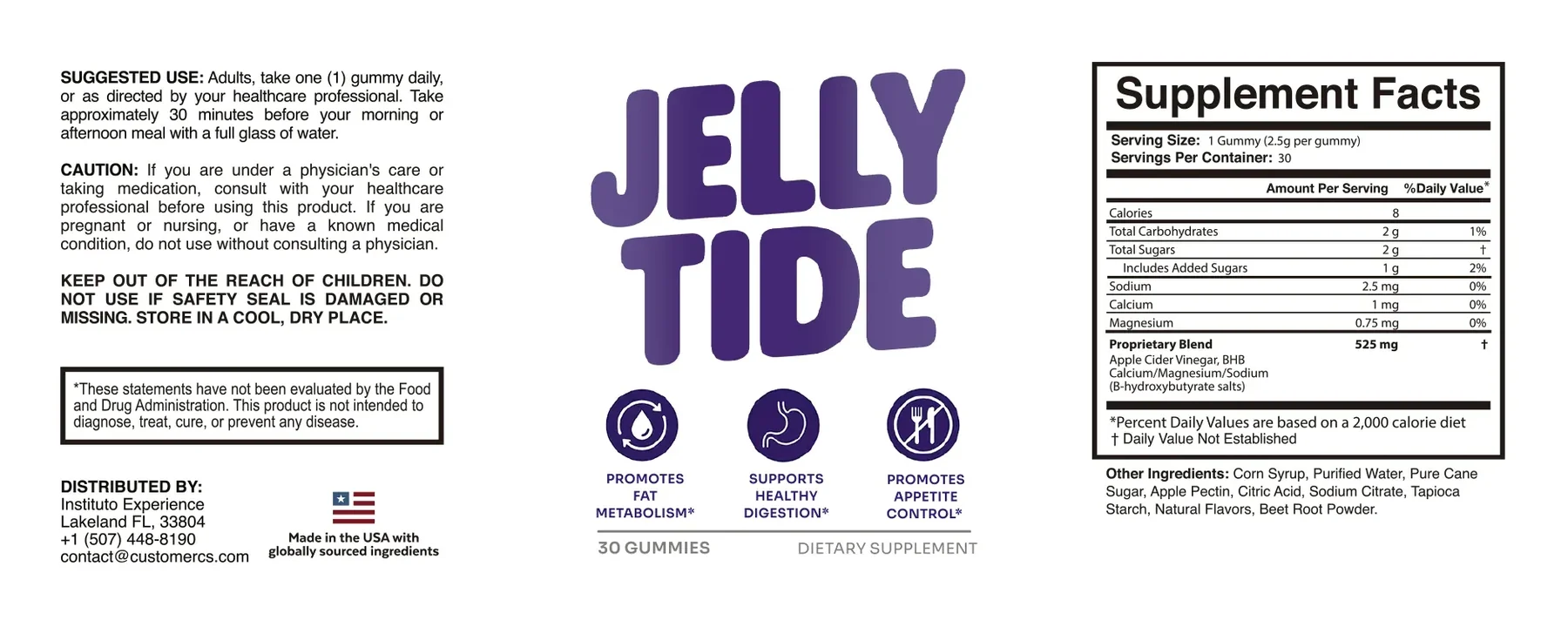
On the product this site covers, the blend reads "Apple Cider Vinegar, BHB Calcium/Magnesium/Sodium" at 525 mg. Descending order means apple cider vinegar is the larger of the two. It does not tell you whether that means 60% or 99%. That same 525 mg total is the number we work through line by line in our assessment of whether JellyTide actually works.
Where a blend leaks information
A blend hides doses, but only inside itself. Anything that also has to appear elsewhere on the panel is still declared. Minerals are the classic case: calcium, magnesium, sodium, potassium, iron and zinc all have their own rows (NIH Office of Dietary Supplements ingredient fact sheets), and those rows count every source in the product, blend included.
So if a blend contains a mineral salt, the mineral row caps how much of that salt can be present. A salt that is 16% calcium by weight cannot contribute more than about six milligrams of salt per milligram of declared calcium. This is arithmetic anyone can do standing in a shop, and it is the single most useful trick for reading a blend.
Caffeine is another leak: it must be declared separately in many markets, and its presence is obvious in the effect anyway. Vitamins with Daily Values are a third.
Three questions worth asking
Is the first-listed ingredient the one I am buying it for? Descending order means the first name dominates the blend. If you are buying a product for the third ingredient listed, you are buying a garnish.
Does any component have a known effective dose? If the research on an ingredient uses grams and the whole blend weighs half a gram, the blend cannot contain an effective dose of it no matter how it is divided. This is the fastest way to rule a product out, and it needs no inside information at all. Gel-forming fibers make the point most sharply: the trials behind psyllium and glucomannan for fullness use several grams a day, which no half-gram blend can hold whatever the split turns out to be.
What do the declared rows imply? Minerals, sugars and calories are all declared, and all of them constrain what can be inside the blend. A 2.5 gram gummy with 8 calories cannot be hiding much.
When a blend is fine
Plenty of good products use them. A blend of botanical extracts where no single ingredient has a precise established dose loses little by being grouped. A probiotic with a total CFU count and a named strain list is genuinely informative. Advertising law is unimpressed either way, since a claim has to be substantiated whether or not the amount behind it is published (FTC Health Products Compliance Guidance). The problem is specific: a blend becomes a way to avoid a conversation when one of its components has a well-known effective dose and the product cannot possibly contain it.
Read the total, read the order, read the rows that leak, and do the division. You will know more than the front of the bottle intends you to, and the remaining checks — format, price per day and what the category can realistically deliver — are set out in the weight loss supplement buyer’s guide.
Medical note: this article is general wellness information, not medical advice, and it reviews published evidence rather than making a product claim. JellyTide is a dietary supplement, not a drug, and is not intended to diagnose, treat, cure or prevent any disease. Speak to a healthcare professional before starting any supplement, especially if you are pregnant, nursing or taking medication.
Frequently asked questions
Are proprietary blends legal?
Yes. US regulations permit grouping dietary ingredients under one name with a single total weight, as long as every component is listed in descending order of weight.
Can I work out individual doses inside a blend?
Not exactly, but you can often bound them. Ingredients that also appear in declared rows — minerals especially — put a ceiling on how much of a mineral-bearing compound the blend can contain.
Does descending order tell me anything useful?
A great deal. The first ingredient named outweighs the second, which outweighs the third. If you are buying the product for something listed last, you are buying very little of it.
Should I avoid every product with a blend?
No. Judge it by whether the ingredients have known effective doses. If they do and the blend is too small to contain them, that is decisive regardless of how it is split.
Sources
See the full label first
The complete JellyTide Supplement Facts panel is transcribed and photographed on the home page, along with the arithmetic on how much of the 525 mg blend can be ketone salt.
Read the panel