Gut Health Supplements Gummies: Sweeteners and the Gut Microbiome
Quick Answer: Do Sweeteners in Gummies Change Your Gut?
In controlled human studies, some non-nutritive sweeteners have measurably shifted the make-up of gut and mouth bacteria in some people — but the shifts were small, differed enormously from person to person, and have not been tied to any clear health outcome. The sweetener load in one daily gummy is a fraction of the amounts those trials used. So gut health supplements gummies are unlikely to reshape your microbiome at one a day, and equally unlikely to repair it.
- Established: several sweeteners reach the colon undigested, where bacteria can act on them.
- Suggestive: randomised trials show real person-to-person differences in microbial and glucose responses.
- Not established: that any of those shifts changes how you digest, feel or weigh.

Why sweeteners became a microbiome question at all
For most of the twentieth century a sweetener was judged on two things: whether it tasted like sugar, and whether it carried calories. The gut was treated as a pipe. That assumption came apart over the last fifteen years, once sequencing became cheap enough to look directly at what lives in the large intestine and how it responds to what arrives there.
Two facts drove the change. The first is that many sweeteners are not absorbed the way table sugar is. Sucrose is split into glucose and fructose and taken up in the small intestine within minutes. A polyol such as sorbitol is absorbed slowly and incompletely, and a high-intensity sweetener such as sucralose passes through largely untouched. Whatever is not absorbed keeps travelling.
The second is what it meets when it gets there. The colon holds a dense bacterial community that handles arriving molecules as substrate, as an osmotic load, or as neither. If a compound is fermentable, bacteria will ferment it and produce gas and short-chain fatty acids. If it is not fermentable but is osmotically active, it draws water. If it is neither, it leaves in the stool unchanged.
That is the entire mechanism behind a decade of headlines. It is genuinely real. It is also considerably narrower than the headlines suggest, because "a molecule reached the colon" and "your health changed" are separated by a long chain of assumptions that the research has not finished testing.
What is actually inside a sweetened gummy
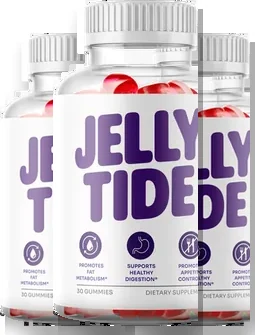
Before arguing about sweeteners in the abstract, it is worth reading a real panel. The JellyTide label is a useful worked example precisely because it is plain. One gummy weighs 2.5 grams and carries 8 calories, 2 grams of total carbohydrate and 2 grams of total sugars, of which 1 gram is declared added sugar. The Other Ingredients line reads corn syrup, purified water, pure cane sugar, apple pectin, citric acid, sodium citrate, tapioca starch, natural flavours and beet root powder.
Notice what is not on that list. No sucralose, no aspartame, no acesulfame potassium, no stevia, no erythritol and no maltitol. It is a sugar-sweetened gummy, which means the entire non-nutritive sweetener literature is largely beside the point for this particular product. That is not a marketing claim; it is what the ingredient statement says, and you can hold it against any competing jar in the same aisle.
It also means the honest question changes. For a sugar-sweetened gummy the relevant question is not "will sucralose disturb my bacteria" but "does one to two grams of added sugar a day matter". Against a diet that already contains anywhere from twenty to a hundred grams of sugar daily, one gram is a rounding error. If you are managing sugar intake tightly for a medical reason, it is still worth counting, and worth raising with whoever manages that care.

What the controlled human trials actually found
The strongest human work in this area comes from randomised trials in which healthy adults were given measured sachets of a single sweetener for a period of weeks, with stool and blood sampling before and after. The best-known of these reported that saccharin and sucralose produced detectable changes in glucose response in some participants, alongside measurable shifts in the composition of stool and oral bacterial communities; a separate randomised crossover trial of aspartame and sucralose reported no significant change in gut microbiome composition at all (Ahmad et al., Nutrients, 2020). Aspartame and stevia were also tested, with weaker and less consistent signals.
Three details from that literature matter more than the headline. First, the effects were not uniform: participants who responded strongly and participants who did not respond at all sat in the same treatment arm. Second, the doses were delivered as isolated sachets, chosen to approach regulatory intake limits rather than to mimic what people typically eat. Third, the follow-up periods were short, usually measured in weeks, which tells you nothing about what happens over years.
Other trials, using ordinary dietary intakes rather than sachets, have reported no meaningful change in microbial composition at all. Both sets of results can be true at once, because dose and delivery are doing the work. This is the ordinary shape of early nutrition science, and it is why "sweeteners wreck your gut" is an overstatement and "sweeteners are inert" is equally an overstatement.
The most reproducible finding in this field is not an effect. It is variation. Two people can take the same sweetener at the same dose for the same two weeks and their gut communities move in different directions.
That variation is scientifically interesting and commercially inconvenient. It means no product, including this one, can honestly promise you a specific microbial outcome. It also means that anecdotes in either direction are close to worthless as evidence, because the population contains genuine responders and genuine non-responders.
See the label before you decide
If you are comparing options and asking which is the best gut health daily supplement, start with the ingredient statement rather than the claim. The full JellyTide Supplement Facts panel, including the sweetener line and the 525 mg blend, is transcribed on this site.
Check Today's OfferSugar, sugar alcohols and sweeteners are three different arguments
A great deal of confusion comes from collapsing three categories into one word. They behave differently in the small intestine, they behave differently in the colon, and the quality of the human evidence differs across them. The table below separates them.
| Sweetener class | Examples | Reaches the colon? | Fermented by bacteria? | Strength of human evidence on gut effects |
|---|---|---|---|---|
| Sugars | Sucrose, glucose, corn syrup | Little, at normal doses | Not usually | Strong on metabolic effects at high intake; weak on direct microbiome effects at low intake |
| Polyols (sugar alcohols) | Sorbitol, maltitol, xylitol, erythritol | Yes, in varying amounts | Yes, except erythritol which is largely absorbed and excreted | Moderate for gas and laxation; weak for lasting compositional change |
| High-intensity sweeteners | Sucralose, saccharin, aspartame, acesulfame K | Mostly yes, in milligram amounts | Limited; they are not efficient fuel | Emerging; short randomised trials with inconsistent, individual results |
| Plant-derived sweeteners | Steviol glycosides, monk fruit | Yes, after bacterial cleavage | Partially | Weak; few controlled trials of adequate length |
| Fibers used as sweetener bulk | Inulin, chicory root fiber, pectin | Yes, in gram amounts | Yes, extensively | Moderate to strong for measurable microbial change, and for gas |
Read the last row again, because it is the one people miss. The ingredient in a sugar-free gummy most likely to change your microbiome is usually not the sweetener at all — it is the bulking fiber used to give the gummy body. Inulin and chicory root fiber are fermented enthusiastically, which is exactly why some people feel bloated on products marketed for bloating. The osmotic half of that story, which is a different mechanism again, is set out in sugar alcohols and digestive tolerance.
Dose is the part that gets lost in the retelling
Every finding in this area is a dose statement wearing a headline. A trial that gives adults repeated sachets of a sweetener is not testing the sweetener in a gummy; it is testing a quantity that would be unusual to reach by eating normally. When that distinction is dropped, a modest result becomes a warning about a product that contains a thousandth of the amount.
The same arithmetic cuts against supplement marketing. A 2.5 gram gummy cannot hold a gram-scale dose of anything except its own sugar and gelling agents. Apple pectin appears on the JellyTide ingredient line, and pectin is a genuine soluble fiber with real fermentation behaviour — but it is there as a setting agent in a fraction of a gram, not as a fiber dose. If you want the fiber effect, you need the fiber amount, which is a different product category entirely. We work through that difference in our comparison of soluble versus insoluble fiber for digestion.
This is the single most useful habit you can build as a shopper: convert every claim into a quantity, then check whether the quantity can physically fit in the serving. It resolves most supplement arguments in about ten seconds and requires no expertise at all.
Where gut health supplements gummies actually fit
Gummies solve a compliance problem, not a biological one. People take them because they taste pleasant and require no water, and adherence is the single largest predictor of whether any supplement does anything at all. That is a real advantage and it deserves to be said plainly rather than dressed up as a mechanism. Where a real dose is the point rather than the habit, a meal replacement shake compared with a fiber jelly shows what the difference in format buys you.
What a gummy cannot do is carry a large dose. The format is bounded by how much active ingredient will dissolve into a pectin or gelatin matrix without ruining texture, which in practice caps most gummies in the hundreds of milligrams. That is fine for ingredients that work in milligrams, such as vitamins and certain minerals. It is a poor fit for anything that works in grams, which includes every fiber with meaningful clinical evidence behind it.
So when a search for the best gut health supplement returns page after page of gummies, the useful filter is not the format but the dose per serving. Ask what the active ingredient is, how much of it there is, and what amount the human research used. If the answer to the third question is grams and the answer to the second is milligrams, the format has already answered your question. Our plain-English breakdown of the JellyTide label applies exactly that arithmetic to this product's 525 mg blend, including how much of it can be ketone salt.
Apple cider vinegar gummies for gut health are a good case study in this. The vinegar research that people cite used tablespoons of liquid vinegar, which is grams of acetic acid. A gummy carries a share of a 525 mg blend. Both facts can be printed truthfully on the same page, and the gap between them is where careful reading earns its keep.
What this evidence cannot do
Being direct about the limits is more useful than another paragraph of reassurance. Here is what the current human data does not support.
It cannot diagnose you. A microbiome test result is not a medical finding, and no supplement described on this page treats, cures or prevents any digestive disease. Persistent bloating, pain, blood, unintended weight change or a sudden change in bowel habit belong in a clinician's office, not in a comparison table.
It cannot predict your response. The variation described above is the finding, which means no one can tell you in advance whether a given sweetener or gummy will suit you. That includes us.
It cannot bridge from bacteria to outcomes. Most studies report compositional change — which organisms are present in what proportion. Very few follow through to symptoms, and fewer still to a hard clinical endpoint. A shift in a bacterial ratio is a measurement, not a benefit.
It cannot substitute for diet. The best supported inputs to gut health remain unglamorous: total fiber intake, the number of different plants you eat in a week, fermented foods, sleep and movement. Nothing in a jar has beaten those in a controlled trial, and any product that implies otherwise is ahead of its evidence.
Medical note: this article is general wellness information, not medical advice, and it summarises published evidence rather than making a product claim. JellyTide is a dietary supplement, not a drug, and is not intended to diagnose, treat, cure or prevent any disease. Speak to a healthcare professional before starting any supplement, especially if you are pregnant, nursing or taking medication.
Frequently asked questions
Do gut health supplements gummies damage the microbiome?
There is no good human evidence that a single daily gummy damages the gut microbiome. Trials that recorded microbial shifts used isolated sweetener sachets at far larger daily amounts than a 2.5 gram gummy carries, and even there the changes were small, varied between people and were not linked to a health outcome.
Are sugar-sweetened gummies better or worse than sugar-free ones for the gut?
Neither is clearly better. A sugar-sweetened gummy contributes one to two grams of sugar, which is trivial against a normal diet. A sugar-free gummy usually swaps in a polyol or a high-intensity sweetener, which can ferment in the colon and cause gas in sensitive people. Choose on the whole formula, not on the sweetener label alone.
Which sweeteners have the strongest human microbiome data?
Saccharin and sucralose have the most direct randomised human data showing measurable shifts in stool and oral bacterial composition. Aspartame and stevia have been studied too, with weaker and less consistent signals. Across all of them the trials are short, small and dosed above ordinary intake.
Can a gummy replace fiber or fermented food for gut health?
No. The best supported inputs to the gut microbiome remain total dietary fiber, plant variety and fermented foods, all of which are eaten in grams per day. A gummy delivers milligrams of active ingredient and cannot substitute for that, whatever the front of the jar says.
Sources
- NIH Office of Dietary Supplements — fact sheet library
- Harvard T.H. Chan School of Public Health — The Microbiome
- Harvard Nutrition Source — Artificial Sweeteners
- Mayo Clinic — Artificial sweeteners and other sugar substitutes
- Ahmad SY, Friel J, Mackay D. The effects of non-nutritive artificial sweeteners, aspartame and sucralose, on the gut microbiome in healthy adults: secondary outcomes of a randomized double-blinded crossover clinical trial. Nutrients. 2020 Nov 6. PMID 33171964
Read the panel, then decide
People searching where to buy apple cider vinegar gummies usually land on a sales page before they have seen an ingredient statement. Do it the other way round: read the 525 mg blend, the sugar line and the suggested use, then choose.
Check Availability